
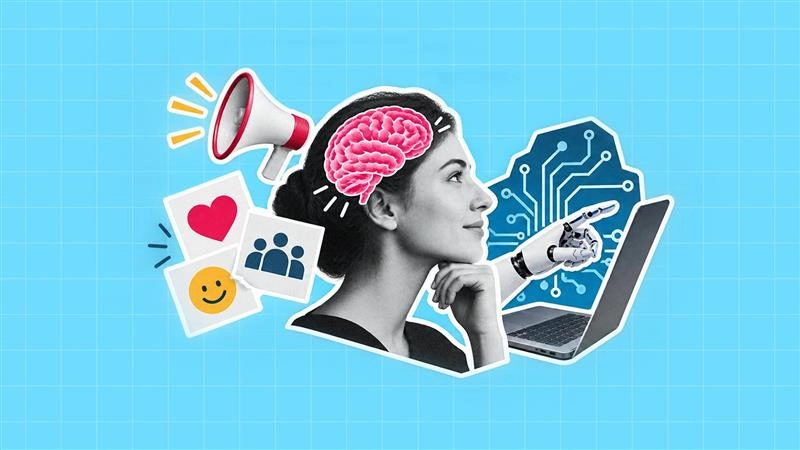
Why Psychology in Marketing Matters More Than Technology?
Summarize this blog post with:

In the modern business landscape, it’s easy to get blinded by the “shiny object” syndrome. We are surrounded by AI-driven analytics, automated CRM sequences, and hyper-personalized retargeting pixels. On the surface, marketing looks like an arms race of engineering.
However, the real truth is that technology is simply the medium through which the psychological processes of human behavior will be conveyed in today’s world of business marketing.
You can build a rapid transit system between two cities; however, if the destination is a place nobody wants to go to, then the project speed has no impact. A “best of breed” technology solution is also only as effective as the audience’s perception of it and its use; therefore, if your message does not connect with the end user through the physical characteristics of their minds and bodies, then you will see no impact on your return on investment (ROI).
Tools vs. Truths
The industry often confuses how we reach people with why people take action.
Technology tells you that a user clicked a link at 2:15 PM on a mobile device.
Psychology tells you they clicked because they felt a “fear of missing out” (FOMO) or because the brand’s color palette triggered a sense of nostalgia and trust.
We’ve automated the “how,” but the “why” remains rooted in an organ that hasn’t had a hardware update in 50,000 years: the human brain. While our gadgets change every six months, human nature is remarkably consistent.
1. The Power of Cognitive Biases
Marketing is essentially the art of navigating the shortcuts the brain takes to make decisions. These shortcuts, or cognitive biases, dictate our purchasing behavior more than any logical spreadsheet ever could.
Social Proof: The Herd Mentality: We are social creatures. When we see a “Bestseller” badge or a notification that “50 people are viewing this hotel right now,” our brains relax. We assume that if others are doing it, it must be safe and correct. This isn’t a technological feat; it’s an evolutionary survival mechanism.
Scarcity and Urgency: The “Limited Time Offer” isn’t a trick of coding; it’s a play on Loss Aversion. Psychologically, the pain of losing an opportunity is twice as powerful as the joy of gaining one. Technology just allows us to display the countdown timer in real-time.
The Anchoring Effect: Ever wonder why a $2,000 watch looks like a bargain after you’ve seen a $10,000 one? The first piece of information we receive (the “anchor”) sets the tone for everything that follows. Marketers who understand anchoring don’t just sell a product; they manage the context of the price.
2. Emotional Resonance Over Feature Lists
If you look at the most successful marketing campaigns in history, Nike’s “Just Do It,” Apple’s “Think Different,” or Dove’s “Real Beauty”, you’ll notice a distinct lack of technical specifications.
Nike doesn’t lead with the synthetic blend of their fabric; they lead with the aspiration of greatness. They aren’t selling shoes; they are selling a version of yourself that doesn’t give up.
The Limbic System vs. The Neocortex
- The Neocortex: Responsible for logic and language. It handles the “features” and “specs.”
- The Limbic System: Responsible for feelings, trust, and loyalty. It has no capacity for language, but it drives all decision-making.
When a brand speaks to the Limbic system, they create a “gut feeling.” Technology can help us target the right person, but only psychology can make that person feel something.
3. The Paradox of Choice
Technology has given us the ability to offer endless options. We can show a customer 5,000 different styles of shoes in three clicks. However, psychology teaches us about Analysis Paralysis.
When presented with too many choices, the human brain gets overwhelmed and often chooses nothing to avoid the potential regret of making the wrong choice. Great marketing is actually the process of curating and simplifying the path to purchase, reducing friction by understanding the limits of human attention.
4. Ritual and Identity
Why do people wait in line for hours for a new iPhone? It’s not because the processor is 15% faster; most users won’t even notice that. It’s because being “an Apple person” is a part of their identity.
Marketing uses psychology to turn products into identity markers. We use brands to signal to the world who we are, what we value, and which “tribe” we belong to.
- Patagonia signals environmental consciousness.
- Harley-Davidson signals rebellion and freedom.
- Tesla signals innovation and status.
Technology manages the e-commerce store, but psychology builds the tribe.
5. The Role of Technology: The Servant, Not the Master
To say marketing is psychology isn’t to say technology is useless. Rather, it defines the relationship between the two.
Technology should be used to scale psychological insights.
A/B Testing: This isn’t just about button colors; it’s a scientific method for discovering which psychological trigger (e.g., “Save $50” vs. “Get $50 Off”) resonates more with your specific audience.
CRM/Personalization: This isn’t about “data mining”; it’s about mimicking the psychological comfort of a “local shop” experience where the owner knows your name and your preferences.
Social Media: These aren’t just “platforms”; they are digital campfires that meet psychological needs for connection and validation.
Conclusion
The best algorithm can’t repair a brand if consumers don’t trust it. The quickest website can’t sell a product that doesn’t address a human need or serve a human want.
As we continue to enter the age of AI and automation, the marketers who will succeed won’t be the ones with the priciest software. They’ll be the ones who know the most about humanity. They’ll be the ones who understand that behind every “user session” and “conversion event” is a real person, driven by fears, pride, dreams, and a beautifully chaotic, irrational mind.
Take a break from thinking about your tech stack and start thinking about your customer’s psyche. Because at the end of the day, marketing is a conversation between two people, technology is just the phone they’re using.
FAQs
While many exist, these three are universal:
- Social Proof: People look to others to determine correct behavior (e.g., reviews, “Join 10,000 others”).
- Reciprocity: When you give something of value for free (like an e-book or a sample), the human brain feels a subconscious “debt” to give something back.
- Authority: People are conditioned to follow the lead of credible experts. Using certifications or expert endorsements builds immediate trust.
There is a fine line between persuasion and manipulation.
- Persuasion highlights how a product legitimately solves a problem or fulfills a need.
- Manipulation uses psychological tricks to coerce someone into a choice that isn’t in their best interest.
- Ethical marketing uses psychology to reduce “friction” and help the right customer find the right solution faster.
AI is excellent at recognizing patterns of behavior (e.g., “People who bought X usually buy Y”), but it doesn’t “understand” the underlying emotion or cultural nuance. AI can help you apply psychological principles more efficiently, but the creative insight, the “Big Idea” that touches a human heart, still requires a human marketer.
Actually, psychology is arguably more important in B2B. Business purchases often involve higher stakes, more money, and the risk of a person losing their job if a vendor fails. B2B marketing must address the psychological need for security, status, and risk-reduction just as much as it addresses technical specifications.
Written by Adam Gibbs
Adam is a skilled SEO content expert with a proven track record of crafting high-quality, keyword-rich content that drives traffic, engages readers, and ranks on search engines. With 10+ years of experience in digital marketing and content strategy, Adam specializes in creating blog posts, website copy, and marketing materials tailored to both audience needs and SEO best practices.
Related Posts
Email Marketing in 2026: What’s Changing and What’s Not?
- All Posts
- SEO

Table of Contents Book Intro Call Case Studies Share: Related Guides: Related Posts How to Verify Your Domain in Meta...

Table of Contents Book Intro Call Case Studies Share: Related Guides: Related Posts How to Verify Your Domain in Meta...

Table of Contents Book Intro Call Case Studies Share: Related Guides: Related Posts How to Verify Your Domain in Meta...

Mastercopy Table of Contents Book Intro Call Case Studies Share: Related Guides: Related Posts SEO Beyond Keywords: Why Schema Markups...
ChatGPT
Perplexity
Claude
Grok